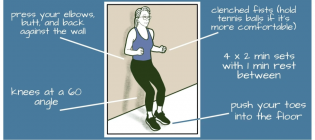
One of our goals with this newsletter is to share the most up to date health and wellness news. Our newsletter from November 2023 discussed three exercises that could be done at home to help manage blood pressure. Please check out that information as it is still relevant. https://kchealthandsport.com/blog/2023-11-exercise-to-help-manage-your-blood-pressure. However, the very latest research adds a new exercise to the program: WALL SQUATS. In this blog we will discuss the latest research regarding the two best exercises for treating and preventing high blood pressure.
A recent study showed that an at-home wall squat exercise program lowered blood pressure by more than 11 points. The more muscles you contract, the greater the reduction in blood pressure. Therefore, during the squat you will also push your elbows back into the wall, clench your fists or squeeze tennis balls and push your toes into the floor. The goal will be to hold the squat for 2 minutes, rest for 1 minute and then repeat the squat for a total of 4 repetitions.
Yes, holding a squat for 2 minutes is difficult and some people may need to start with a 30 second squat and increase the time by 10 seconds a week until you are holding the squat for 2 minutes. You should be moderately fatigued after doing 4 squats with a 1-minute rest break between squats. Perform the wall squat routine every other day.
The protocol of 4 squats held for 2 minutes each is an extremely effective way to safely reduce blood pressure. The great news is that after following the routine for three weeks, you only need to do it once a week to keep your blood pressure at its improved level! The wall squat exercises are not only beneficial in managing high blood pressure, but they may also be helpful in preventing this difficult to treat condition. Prevention is the best medication so get started on your wall squats today!
Another effective way to lower blood pressure is to strengthen your diaphragm. A muscle training program where resistance was applied while breathing in lowered systolic pressure (the top number in a blood pressure reading) by almost 16 points and diastolic pressure (the bottom number) by 7 points.
The easiest way to perform diaphragm muscle strengthening is with a respiratory training device that can be purchased online for about $20. The typical conditioning protocol is to perform 30 inhales at 75% full effort. Which means when you finish your final inhale you should be moderately fatigued. You can increase or decrease the resistance if the exercises are too easy or difficult simply by turning the dial on the respiratory training device. The breathing exercises should be done 6 days a week for 6 weeks. Although, that might sound like a big commitment, the diaphragm exercises only take about 2 minutes per day to complete. They are easy to perform and produce good outcomes.
Isometric hand grip exercises and stretching the calf, quadriceps, hamstrings and chest which stretch large arteries in your legs and arms have also been shown to also help reduce blood pressure. It is possible to effectively lower blood pressure with a few simple home exercises. Considering hypertension is present in more than 65% of the American population over the age of 60; these exercises can also be used by people all ages to help prevent high blood pressure. Contact Advanced Healthcare and Sports Injury for help setting up your wellness program. People with a history of poorly controlled hypertension should consult their doctor before beginning any of these exercises.
References: Michaud, Tom. The Two Best Exercises for Treating/Preventing High Blood Pressure. Human Locomotion.